Archive for the ‘design process’ Tag

Bringing Emotion into the Design Process

Monday, March 10th, 2008

I’d like to continue a comment about bringing emotion into the design process because I think it deserves its own post. Kip said:

Design has some valuable roots in its ties with emotion, but in many ways we’ve lost touch. Can we bring a sophisticated discussion of “emotion” back on the table and include it in our design process?

I don’t know if we’ve lost touch or if emotion has been neglected in the bustle of quickly changing technology and products. But I think we can do more to bring emotion into the process. There might be an expectation that design is by default about emotion, and it does not need much attention.

Looking at my Basic Interaction design syllabus, emphasis is placed on the design process and methods. Although some of the methods, like personas and narrative scenarios are supposed to help get at the motivations and the experience, and by extension, the emotions. Video sketching is another method that I think helps to understand what the emotional aspects of the product might be like. Though we typically talk about video sketching as being about the experience, which leads me to ponder the relationship of emotion and experience in design (thesis paper topic for some grad student?).

I remember a recent comment about “shit in, shit out” in regards to the design process, which I took to mean you get what you bring into it. If you aren’t excited about the design process or problem, for example, your solution will not be very exciting. Perhaps if you are not emotional or consider emotion throughout the process, emotion will not be a strong component of your solution.

Last semester, when Kip and I were working on our TSA service design project, we spent a lot of time considering the emotional aspect of going through airport security. Taking lots of photos of people in context and having those photos surround us during design meetings really helped keep emotion at the forefront of our discussions. Though it also helped that we are both very aware of and keen to recognize the role of emotion in design.

Kip at the board

Another suggestion I heard last summer at Adaptive Path came from Dan Saffer, who suggested considering the aesthetics sooner using an image, music, or word. This is similar to my experience with the TSA project, where we referred to certain photos to constantly remind us of the emotions involved currently and those we wanted the end result to embody.

Masters Thesis Paper

Tuesday, February 19th, 2008

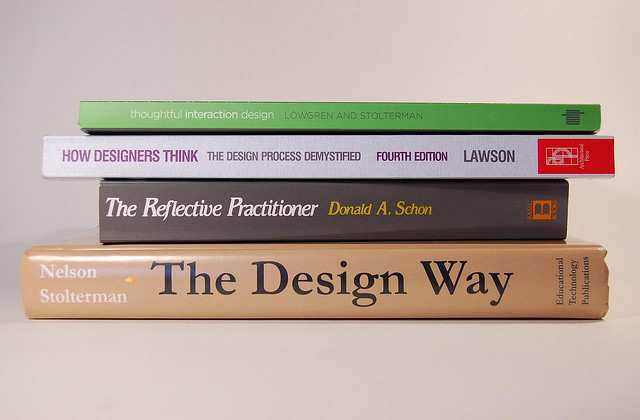
Thesis Paper Books

My thesis paper explores the thinking aspect of design to understand what it is designers actually do so that we can understand our value and communicate it to others. To this end, I read several books, including The Design Way, The Reflective Practitioner, How Designers Think, and Thoughtful Interaction Design. In addition, I reference The Sciences of the Artificial, Designerly Ways of Knowing, and Design Methods.

Advisor: Jodi Forlizzi

Abstract

What designers do—the thinking behind design—is not fully understood. Design is still often viewed as a black art rather than a rigorous discipline. Designers themselves have difficulty explaining how they make the connections that lead to the final solution and why those judgments are valid. While good design work can be done without understanding these forces, it is my hypothesis that the more designers know about the forces involved in design thinking and process, the better they will become as designers and the better they will be able to communicate design to others. This paper examines design as an approach to solving problems and what makes it different from other approaches. It examines design thinking as desire for a particular outcome, a philosophic viewpoint, a conversation, imagination, reason, judgment, wisdom, and a skill. And it explores the nonlinear, dialectical, and unique nature of the design process. Finally, it suggests that designers can view the development of understanding and ability as a design endeavor itself, and that it is possible to design oneself as a designer. Though the audience and focus is on designers, it is my belief that a better understanding of design along with increased ability to communicate design’s rigor and value will ultimately benefit and advance the discipline as a whole.

Download the final paper (pdf)

(Final?) Thesis Paper Abstract

Friday, January 18th, 2008

Next Friday is thesis paper presentation day, where each second-year graduate student has 10 minutes to present his or her thesis paper and five minutes to be interrogated about it. This is a major milestone of this year. Lucky me, I get to present first!

In preparation, I had to submit the thesis title and abstract for the program. This was difficult because, while I have around 8,000 words written, the argument as a whole is still being shaped. Naturally, I spent the whole day coming up with the title and the 250-word abstract, finishing exactly at 5 pm. Or you might say that in typical designer fashion, I worked solidly until the absolute last second tweaking it.

Here’s the final tweak.

The Thinking Behind Design

For the past several hundred years, science and humanities have enjoyed prominence in our culture and education. Science and a scientific approach to solving problems have received bias in our educational systems and our work. But increasingly, design is being recognized as a valuable approach to solving complex problems and creating inventive solutions. However, understanding what designers do—the thinking behind design—is not fully understood. Design is still often thought of as a black art rather than a rigorous discipline. If design is to advance as a discipline, understanding design thinking becomes paramount. Design is a relationship between the design way of thinking, the process of carrying out that thinking, and the embodiment of the thinking and the process within the designer. The process of developing design thinking is a design process in itself. It therefore may behoove designers to recognize designing oneself as a designer as fundamental to improving design ability. Understanding design thinking will also help designers articulate their value and communicate what is it they actually do in a way that demystifies the process and instills a sense of trust in their solutions. This paper examines how designers think and the relationship between design thinking and the design process to better understand what designers do, the rigor of their process, and the value of skilled designers.

And if you want to compare, here are the previous iterations:

Hugh Dubberly Models Innovation

Tuesday, January 15th, 2008
“For the past few years, innovation has been a big topic in conversation about business management. A small industry fuels that conversation with articles, books, and conferences.

Designers, too, are involved. Prominent product-design firms offer workshops and other services promising innovation. Leading design schools promote “design thinking” as a path to innovation.

But despite all the conversation, there is little consensus on what innovation is and how to achieve it.”

That is the opening of “Toward a Model of Innovation” by Hugh Dubberly in the current issue of Interactions. He further asks if innovation can be tamed. The article proposes a model of innovation (download pdf), not as an absolute, but as a starting point for further explanation and conversation.

While he is speaking about the innovation process, I draw very close parallels to the design process. “Of course, innovation processes are rarely linear,” the article states. This is the same for the design process, and why people with linear thought processes and a more scientific mindset have a difficult time with the design process. In my thesis, I argue that a better understanding of the thinking behind the design process will enable people to become better designers, and perhaps help the advancement of design as a discipline.

I am also looking at models of the design process to highlight the benefits and weaknesses of models in understanding and trying to practice design. The current slew of publications about innovation and the many links to design within them has me wondering about the effectiveness of the random article has in helping people learn and practice design. While I ascribe to the idea that everyone designs, I worry that there isn’t enough emphasis on the difficulty of producing good designs. Dubberly at least gives a nod to this regarding innovation: “Innovation remains messy, even dangerous. Luck and chance—being at the right place at the right time—still play a role.”

“Dangerous” is a provoking word choice. Design, or innovation, does not necessarily equal good. Many terrible products, movements, and societies have been designed for evil. Should we be worried about the design process increasing the generation of evil?

Another large factor in the design process and the innovation process (assuming a difference) is the role of the individual. The article recognizes this: “The map posits individuals as drivers of innovation—and the source of insight.” In my thesis, I argue that one of the missing pieces of design process models is the designer, who has extreme influence on the process. The designer actually designs the process each time, which makes each design process unique, and thus difficult to produce a single model.

Paul Pangaro, CyberneticLifestyles.com CTO, contributed to Dubberly’s model and raised some other good questions about modeling innovation:

“What parts of the process of innovation are messy, unpredictable, ineffable, mystical, magical, and intuitive? The more that innovation is those things, the less we can help the process and make a deliberate innovation; at one extreme, that phrase becomes an oxymoron. Conversely, what parts of innovation are predictable, likely, improvable, or even deterministic? We certainly resist the idea that the source of inspiration, the source of hypotheses, can be fully known, reduced to an algorithm.”

Good questions and consideration for design as well, I say.

How I Became a Designer

Thursday, December 27th, 2007

This post is inspired by Jack Moffet’s Mystory, which was inspired by a recent IxDA discussion on when/where/how you decided to become a designer.

To answer this question, I could go through my life story—army » engineering » poetry » journalism » web producer » editor » web developer—but that would be rather long and tedious (for me, fascinating for you!). Instead, I’ll skip to the end.

I recognized myself as a designer some time after my first semester in the interaction design graduate program at Carnegie Mellon, about a year ago. I say “recognized” because in retrospect I had been practicing design, but not fully and without understanding design as a rigorous approach to solving problems. Prior to that recognition, I did not think of myself as a designer.

After being educated about and exposed to the design process and design thinking, I realized that the design way of solving problems was not foreign to me and therefore my experience was not zero. But I began to think of myself as a designer only after recognizing that my thinking and my process were designerly. I suppose it was then that I chose to be a designer. By choosing, I committed myself to the development—or the design—of myself as a designer. Being immersed in a graduate program has enabled me to accelerate this process.

That’s not to say that I think everyone needs to go to school to be a designer (it certainly helps). But transitioning from a non-design role to a professional designer isn’t something you can just pick up by reading a couple BusinessWeek articles about design thinking. In fact, I think the current business focus on design, while good in raising awareness of a design approach, may actually be harmful because it does not emphasize the difficulty of producing good solutions, the irrational, nonlinear nature of the process, the need for experience and design wisdom, and the traits that make people good designers. The need for design has been identified, but not how to shift the linear, number-crunching culture to design culture.

But I digress (into thesis paper territory). My point is that being a designer is a journey, a process. It’s not easy, nor is it for everyone. It feels right for me, despite having somewhat blundered into it. So I feel quite lucky to call myself a designer.

Thesis Paper Abstract v3

Friday, November 30th, 2007

After my Thanksgiving thesis paper writing blitz, I realized I needed to once again revise the abstract to more coherently attempt to express the aim of my paper. While I’m still not 100 percent happy with it, the following abstract represents my latest direction for my paper.

It is difficult to talk about the design process without also talking about design thinking, for almost everything of importance in the design process is a result of thinking. Understanding the design process is therefore not just about procedures and models, but also involves understanding the mindset of the designer and the designer’s role within the process. In fact, bringing design to a situation is not simply a matter of following a predefined model or method, because each process is unique. This is a result of the design process itself needing to be designed. Models of the process, therefore, can only act as abstract representational tools that aid the designer in designing the design process. The effectiveness of the design process is thus contingent on the ability of the designer. To be good at design, designers need to understand the nature of design thinking and how it differs from scientific thinking. Designers also need to be reflective of their process, challenging their own thinking and assumptions. This is critical in tackling complex design problems, which inherently have no given solution. Developing ones design ability, or design judgment, requires critical reflection of both the design problem and solutions. For it is through recognition of good design that design judgment skills are cultivated. Highly developed judgment skills are what form the rigor of the design process, and provide the means to make the creative leaps necessary to transcend the limitations of the present and design successful products and services of the future. It therefore may behoove designers to recognize designing oneself as a designer as paramount to achieving good solutions from the process of design. Understanding the design process, design thinking, and the role of the design will also help designers articulate their value and communicate what is it they actually do in a way that demystifies the process and instills a sense of trust in their solutions.

Feedback is welcome.

Exploration of Possibility

Friday, November 23rd, 2007

Thanksgiving break for me means time to focus on my thesis paper for more than a day. And I am thankful for that.

However, I continue to struggle to stay focused. My paper calls for me to review my notes. My notes lead me to the books I read. The books I read beg for me to read them again. Chapters that probably aren’t relevant become extremely interesting. The next thing I know I’m not writing any more, and am wondering if my paper isn’t really about whatever I’m reading, or possibly something else I haven’t read.

Harold Nelson and Erik Stolterman might call what I’m experiencing as a combination of analysis paralysis—generation of too much divergent information without a means for convergence—and holistic paralysis—attempting to be comprehensive.

“We can never know all there is to know and can go on gathering facts forever. As designers, we must face this reality and not expect to be completely comprehensive; instead, we must endeavor to construct meaning out of the complexity and chaos that constitutes the real world. This is an action of exploration of possibility.” —Nelson and Stolterman, The Design Way

This snippet came at the right time. Like the design process, I need to move forward with what I have, trusting myself to make meaning out of the complexity and chaos I have already uncovered. By the end of this weekend, I will have finished a complete draft of what I intend my thesis paper to be—an action of exploration of possibility.

Thesis Paper Abstract v2.0

Friday, October 26th, 2007

With the majority of my readings behind me—How Designers Think, The Reflective Practitioner, Thoughtful Interaction Design—I took a stab at rewriting my thesis paper abstract. I wrote the original abstract a few weeks ago, but it was still too abstract for…um…an abstract, so I didn’t share it.

The result is a shift, I believe, from my original proposal, but still within the same vein.

Interaction design’s strongest ties are to design. To understand the value of interaction design, the process of the interaction designer, and what is good interaction design, we need to understand the process of design, and the process of a designer. It is not a scientific process, and therefore difficult to describe the rigor of the process. Some ascribe the design process as a black box or a magical process where you put something in and without explanation a solution pops out. While the design process is difficult for designers to explain, there is strong evidence of a rigorous process that designers follow based on skill and knowledge that enhances a designer’s ability to consistently produce quality solutions. How do interaction designers make the leap that enables them to envision and design what could be? This paper will examine the process, what makes a good designer, how it applies to interaction, and what interaction designers can do to advance their design ability.

It’s still not quite right, but it’s getting there.

What I’m interested in most (maybe) is understanding the actual design process, the simultaneous problem framing and problem solving, and the rigor of design that differs from a scientific approach. I’m also curious about the role of design process models, and ways to communicate the process and the value of design to non-designers.

I have a laundry list of other things I find interesting, and a few more books to digest—The Design Way, Designerly Ways of Knowing. But I’m going to lay off the readings for a while, and begin making my thoughts more concrete through writing.

Why do people want models?

Tuesday, October 9th, 2007

This post is really just a collection of thoughts stemming from my last thesis paper meeting. I’m still mostly reading at this point and sort of framing the argument along the way.

My original inquiry had to do with the leap of faith from design research to design concepts. This has led me to a focus on design process and how designers approach problems.

Some ways of shaping my argument include:

  • Can we teach the “black art” of design to non-designers?
  • Ways for non-designers to become comfortable with the design process.
  • If we can’t talk about design, how do we tell it to others?
  • Clients are OK with visual design and product design, so why is everyone so freaked out by interaction design?
  • Why do people want models? Process?

Some recent great quotes I’ve pulled from How Designers Think include:

  • “None of the writers quoted here offer any evidence that designers actually follow their map.”
  • “It is often not possible to say which bit of the problem is solved by which bit of the solution.”

One idea that has some resonance with me has been that the actual design process cannot be explained, and that every attempt is a reflective act that makes the process seem more logical than it actually is. This may be the problem I have had with trying to define the design process all along, as I recognized mid-process that I couldn’t explain how things were moving forward while acknowledging that the progress was in fact fruitful.

I’m not sure if that notion makes the step-by-step lists for plowing through the design process a useful act of faith or just completely useless to non-designers. Perhaps I will gain more insight the more I read and digest.

After finishing How Designers Think, I plan to move onto The Reflective Practitioner in earnest, and also Thoughtful Interaction Design, which arrived today.

So why do people want to model the design process? It’s complicated and mysterious, and like me, people want to understand. But what if the answer turns out to be, for all our effort, we can’t understand the design process, at least not in full?

Defining Design

Thursday, October 4th, 2007

Is defining design a worthwhile endeavor? Or should we just get on with it, do what we do and not analyze it so much?

My rather amorphous thesis paper revolves around the process of design research to design concepts, supposedly within the realm of interaction design, but so far not really staying within that boundary. In each reading, there invariably exists an attempt to define design, or sometimes an acknowledgment that a definition may not exist, or isn’t even the point.

“The answer is probably that we shall never really find a single satisfactory definition but that the searching is probably much more important than the finding.” —Bryan Lawson, How Designers Think

I found Lawsons idea similar to thoughts I had during the Emergence conference while witnessing for the second year in a row the struggle to define service design. The question that first came to mind was why everyone felt a need to define service design. From that, I jumped to the conclusion: What if we were able to define service design in a way that everyone agreed? What then?

Similarly I wonder about design in general. Lawson’s book was first published in 1980, but his insights are still relevant because we are still having the same conversation. What is design?

To answer my own question of what would happen if we were able to define and agree on a definition of design, design would become paralyzed and die.

Design. Die? What?

It sounds ridiculous that design could die. But perhaps it is also ridiculous to think we can define design, even though we must. For if we collectively became conscious of the futilely of our passion to define design, we might stop trying, and in doing so cease the momentum of design.

Thus I argue that the constant attempt or conversation of trying to define design is necessary for the advancement of design, even though the presumed end goal is futile. In this respect, Lawson is right when he says “the searching is probably much more important than the finding.”

So continue your search and forget what I said, for I don’t want to go down in the books as the man who killed design.

Portfolio

About

I am a graduate interaction design student at the School of Design, Carnegie Mellon University. » More about