Archive for the ‘thesis’ Tag

Done with Grad School! (the short post)

Thursday, May 15th, 2008

At 10am this morning, I turned in my signed thesis paper and thesis project, making me officially done with grad school. It’s been pretty quiet on this site the past couple weeks as I tried to get everything complete. This short post is meant to break that silence. But as I have spent many sleepless nights the past week, I’m exhausted and in dire need of a beer, I am keeping this brief.

Graduation is on Saturday. It’s a relief to be done, though I don’t think the reality of what that means has sunk in yet. Congratulations to all of my peers.

Look forward to a longer, more reflective post to come, when I have more energy.

Masters Thesis Paper

Tuesday, February 19th, 2008

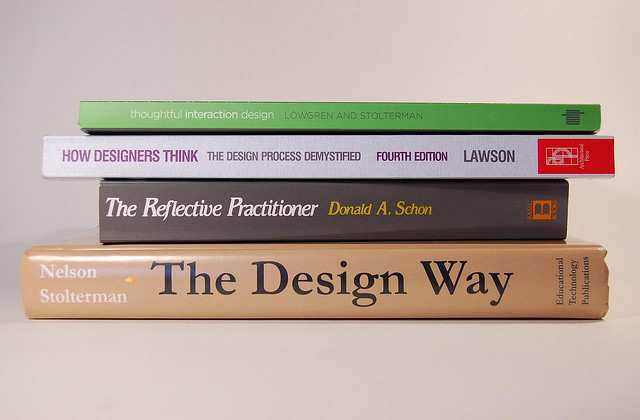
Thesis Paper Books

My thesis paper explores the thinking aspect of design to understand what it is designers actually do so that we can understand our value and communicate it to others. To this end, I read several books, including The Design Way, The Reflective Practitioner, How Designers Think, and Thoughtful Interaction Design. In addition, I reference The Sciences of the Artificial, Designerly Ways of Knowing, and Design Methods.

Advisor: Jodi Forlizzi

Abstract

What designers do—the thinking behind design—is not fully understood. Design is still often viewed as a black art rather than a rigorous discipline. Designers themselves have difficulty explaining how they make the connections that lead to the final solution and why those judgments are valid. While good design work can be done without understanding these forces, it is my hypothesis that the more designers know about the forces involved in design thinking and process, the better they will become as designers and the better they will be able to communicate design to others. This paper examines design as an approach to solving problems and what makes it different from other approaches. It examines design thinking as desire for a particular outcome, a philosophic viewpoint, a conversation, imagination, reason, judgment, wisdom, and a skill. And it explores the nonlinear, dialectical, and unique nature of the design process. Finally, it suggests that designers can view the development of understanding and ability as a design endeavor itself, and that it is possible to design oneself as a designer. Though the audience and focus is on designers, it is my belief that a better understanding of design along with increased ability to communicate design’s rigor and value will ultimately benefit and advance the discipline as a whole.

Download the final paper (pdf)

(Final?) Thesis Paper Abstract

Friday, January 18th, 2008

Next Friday is thesis paper presentation day, where each second-year graduate student has 10 minutes to present his or her thesis paper and five minutes to be interrogated about it. This is a major milestone of this year. Lucky me, I get to present first!

In preparation, I had to submit the thesis title and abstract for the program. This was difficult because, while I have around 8,000 words written, the argument as a whole is still being shaped. Naturally, I spent the whole day coming up with the title and the 250-word abstract, finishing exactly at 5 pm. Or you might say that in typical designer fashion, I worked solidly until the absolute last second tweaking it.

Here’s the final tweak.

The Thinking Behind Design

For the past several hundred years, science and humanities have enjoyed prominence in our culture and education. Science and a scientific approach to solving problems have received bias in our educational systems and our work. But increasingly, design is being recognized as a valuable approach to solving complex problems and creating inventive solutions. However, understanding what designers do—the thinking behind design—is not fully understood. Design is still often thought of as a black art rather than a rigorous discipline. If design is to advance as a discipline, understanding design thinking becomes paramount. Design is a relationship between the design way of thinking, the process of carrying out that thinking, and the embodiment of the thinking and the process within the designer. The process of developing design thinking is a design process in itself. It therefore may behoove designers to recognize designing oneself as a designer as fundamental to improving design ability. Understanding design thinking will also help designers articulate their value and communicate what is it they actually do in a way that demystifies the process and instills a sense of trust in their solutions. This paper examines how designers think and the relationship between design thinking and the design process to better understand what designers do, the rigor of their process, and the value of skilled designers.

And if you want to compare, here are the previous iterations:

Exploration of Possibility

Friday, November 23rd, 2007

Thanksgiving break for me means time to focus on my thesis paper for more than a day. And I am thankful for that.

However, I continue to struggle to stay focused. My paper calls for me to review my notes. My notes lead me to the books I read. The books I read beg for me to read them again. Chapters that probably aren’t relevant become extremely interesting. The next thing I know I’m not writing any more, and am wondering if my paper isn’t really about whatever I’m reading, or possibly something else I haven’t read.

Harold Nelson and Erik Stolterman might call what I’m experiencing as a combination of analysis paralysis—generation of too much divergent information without a means for convergence—and holistic paralysis—attempting to be comprehensive.

“We can never know all there is to know and can go on gathering facts forever. As designers, we must face this reality and not expect to be completely comprehensive; instead, we must endeavor to construct meaning out of the complexity and chaos that constitutes the real world. This is an action of exploration of possibility.” —Nelson and Stolterman, The Design Way

This snippet came at the right time. Like the design process, I need to move forward with what I have, trusting myself to make meaning out of the complexity and chaos I have already uncovered. By the end of this weekend, I will have finished a complete draft of what I intend my thesis paper to be—an action of exploration of possibility.

Thesis Paper Abstract v2.0

Friday, October 26th, 2007

With the majority of my readings behind me—How Designers Think, The Reflective Practitioner, Thoughtful Interaction Design—I took a stab at rewriting my thesis paper abstract. I wrote the original abstract a few weeks ago, but it was still too abstract for…um…an abstract, so I didn’t share it.

The result is a shift, I believe, from my original proposal, but still within the same vein.

Interaction design’s strongest ties are to design. To understand the value of interaction design, the process of the interaction designer, and what is good interaction design, we need to understand the process of design, and the process of a designer. It is not a scientific process, and therefore difficult to describe the rigor of the process. Some ascribe the design process as a black box or a magical process where you put something in and without explanation a solution pops out. While the design process is difficult for designers to explain, there is strong evidence of a rigorous process that designers follow based on skill and knowledge that enhances a designer’s ability to consistently produce quality solutions. How do interaction designers make the leap that enables them to envision and design what could be? This paper will examine the process, what makes a good designer, how it applies to interaction, and what interaction designers can do to advance their design ability.

It’s still not quite right, but it’s getting there.

What I’m interested in most (maybe) is understanding the actual design process, the simultaneous problem framing and problem solving, and the rigor of design that differs from a scientific approach. I’m also curious about the role of design process models, and ways to communicate the process and the value of design to non-designers.

I have a laundry list of other things I find interesting, and a few more books to digest—The Design Way, Designerly Ways of Knowing. But I’m going to lay off the readings for a while, and begin making my thoughts more concrete through writing.

Design Ability: Skill and Knowledge

Tuesday, October 23rd, 2007

When examining the design process, you cannot leave out the designer herself. As I have been exploring different readings and thoughts about the process, several questions have come to mind:

  • What is good design?
  • What is a good designer?
  • How does one become a good designer?

Thoughtful Interaction Design by Jonas Lowgren and Erik Stolterman devotes a whole chapter to the designer, a subsection that addresses design ability.

“Every designer needs knowledge and skill related to her specific profession. Having knowledge means understanding the vast amount of specific information and techniques existing within any design field. Skill concerns the necessary craftmanship. Both knowledge and skill are needed if a person wants to be a good designer.”

Continuing, abilities required to be a good interaction designer are stated thusly:

  • Creative and analytical ability
  • Critical judgment
  • Rationality and ability to communicate
  • Knowledge of technology and material
  • Knowledge of technology use
  • Knowledge of relevant values and ideals
  • Ability to appreciate and compose aesthetic qualities

It is suggested that developing these abilities is a personal journey: “everyone has to develop her own way of becoming a good designer.” Lowgren and Stolterman then suggest that becoming a good designer is a question of “designing oneself as a designer.”

For me, this statement collides with my thesis project, which explores identity and self expression: how products, services, and perhaps people you know act as a means of designing yourself. I have wondered about designing myself as a designer, transforming myself into an interaction designer through school, embracing of the subject matter, and surrounding myself with markers and stickies.

Well, perhaps. Lowgren and Stolterman say, “that to act as a designer, you have to be able to think about yourself as a designer.” They continue, “Becoming a good designer is to some extent a design endeavor, and not an easy one.”

I agree, becoming a good designer isn’t easy, which is why there is a lot of bad design, and will likely continue to be a lot of bad design. The situation reminds me of writing. Nearly everyone can write. Just like everyone can design by picking out clothes to wear and paint for their houses. However, not everyone can write well. Nor can everyone design well.

Beginning Thesis Paper Readings

Thursday, September 13th, 2007

With Emergence over, my attention has turned to my neglected theses endeavors. Earlier this week I bought a bunch of books, some of which arrived the past few days.

  • Sketching User Experiences: Getting the Design Right and the Right Design (Interactive Technologies) by Bill Buxton
  • The Sciences of the Artificial by Herbert A. Simon
  • Design Methods by John Chris Jones
  • How Designers Think: The Design Process Demystified by Bryan Lawson
  • Design Thinking by Peter G. Rowe
  • A Sense of Self: The Work of Affirmation by Thomas J. Cottle

I skipped right to the end of How Designers Think to a chapter called “Towards a model of designing” as I’m interested in model that attempts to explain what’s happening between research and actual design. I found the following tidbits intriguing.

Unfortunately, the really interesting things that happen in the design process may be hidden in designers’ heads rather than being audible or visible.

And…

Designing is far too complex a phenomenon to be describable by a simple diagram.

I’m wondering if these two statements alone make my investigation moot.

CHI Is Not a Design Conference

Friday, August 3rd, 2007

Call for papers for CHI2008 went out recently, and this sparked some chatter on the IxDA list.

The following is a response to the organizing committee having two conference chairs from Microsoft, and CHI’s perception as an academic conference.

Jonathan Arnowitz
Today 9:28amHI Will,

Your first two points are a bit contradictory: Microsoft is not academia. But I agree your perception of CHI is the more common one; however, also as the co-Chair of the design track I would say your thinking of the conference is a bit dated. (Look at CHI2007 web site and also CHI2008 and you will see a significant dedication to practitioner as well as academic content) . In the past few years, there has been an extra-ordinary growth in practitioner-oriented content in the conference along side the academic research. Indeed, sending this Call for Participation/Volunteer to this group is part of the ongoing efforts to include more practitioner content and more practitioner reviewers.

CHI also is not a design conference, but rather an HCI conference with a design/practioner component. In this way it is a unique conference that mixes both research and design. For more practitioner oriented conferences there are now many to choose from (DUX, IA Summit, UPA and of course now IxDA’s own conference this February) . However as a place to meet and exchange ideas with people all over the HCI map, CHI remains the place to be (mind you being in Florence helps).

What stands out for me is “CHI also is not a design conference.” As someone whose thesis project plan includes submitting to CHI, I will definitely have to bring this up with my advisor. I don’t mind submitting a paper in conjunction with my thesis. But why not to a design conference?

Reconsidering Thesis Project

Tuesday, July 3rd, 2007

Over the weekend I was talking to a designer who created a skirt that lit up when you twirled. That’s great and all, but it seems like a lot of wearable projects do only that: light up given some condition.

This got me thinking about wearables and the challenge of making a wearable that really enhances human life. I then wondered if my thesis project proposal, which dabbles in the world of social networking and representation of self, is what I really want to be dealing with.

Here is my current proposal (not to be confused with my thesis paper proposal):

Co-creation of Identity

Social networking and online personas provide opportunities for people to design their representation of self. But these representations may be difficult for people to articulate accurately or may be bias toward a flawed perception of self.

I want to explore a system that allows others within the social networking community to help in the creation process so that instead of an identity created with the bias of the individual, the identity becomes a truer reflection of both the self and perception of others.

The aim of this project would be to help young adults better understand themselves and how they are perceived by the community. Specifically, my project will focus on college freshmen, who are going through a transition in understanding their identity within a new community.

A goal of this project is to help the target group proactively work to improve there representation within the community, with the hope of also improving their understanding of self in the analog world.

The end product will be specifications for a service that would facilitate the aforementioned interaction.

I still think this is interesting, and touches upon my recent observation people creating Miis. But I worry that I’m not pushing boundaries, not treading in the territory of interaction design challenges on horizon.

Thesis Paper Proposal

Tuesday, June 5th, 2007

I had a conversation today with a Henning Fischer, a coworker at Adaptive Path, about design process, which got me blabbering something about my thesis paper proposal, tentatively titled the Leap from Research to Design in Interaction Design. I had not looked at it since writing it during finals week, so tonight I read what I wrote.

I cringed a bit while reading it, and invite you to cringe along with me.

Only so much can be gained from user research. At some point, the designer must make a leap from what are seen as the user needs and desires to something that doesn’t exist and that users alone could not identify.

Designers have a reputation for performing magic in the creation of new and innovative products, rather than by a rigorous process that other disciplines and clients understand. Although there have been efforts to establish methods, tools, and models for design practice, designers also need to be flexible enough to create their own tools and methods, diverging from codified methods and models.

Interaction designers need to understand the leap from user data to design in both their own process and in communicating their value to others. I want to explore attempts to model this process, whether they work, and perhaps suggest a new model for understanding the mysterious forces of design in interaction design.

I love my strategic use of “perhaps.” Perhaps I chose it because a model is not what I want to create.

A couple months ago I talked with Shelley Evenson about models and design process. She suggested that there isn’t a single process that can be employed because each design problem is unique. Processes are derived from the needs demanded by the problem. I felt this was a good perspective, and true to my experience.

When I told Henning I was interested in Adaptive Path’s design process, he seemed to interpret that I meant a modeled process. So he said AP does not have one. Good, I thought. But there is still a process. And it remains a curious thing how designers bridge user research to design solution, and that’s what I’m interested in for my thesis paper.

Wrestling with this issue came from my experience this past semester in translating user needs into something that doesn’t exist and that users could not ask for directly because of its nonexistence, and also with trying to evaluate the how user research was indeed influencing the end result even when it seemed like at some point the research was being forgotten. It seemed important to both understand the value of user research and at the same time forget about it.

It also arose from the many readings from the last semester, many of which came from the HCI community. There seems to be some effort to model design. I see HCI embracing design, but applying it’s scientific and analytical slant—wanting to quantify the process. This seems to also have an influence on the interaction design discipline, at least from an academic perspective. I understand the need to demonstrate the value of interaction design, but modeling the process like a quantifiable thing troubles me. It doesn’t feel right.

Portfolio

About

I am a graduate interaction design student at the School of Design, Carnegie Mellon University. » More about