Archive for the ‘Jodi Forlizzi’ Tag

Southwest Airlines Spirit Mag Mentions MetaMe

Thursday, October 9th, 2008

The October issue of Southwest Airlines Spirit magazine features innovative work at Carnegie Mellon University. The key ingredient: human understanding.

The article mentions work involving Jodi Forlizzi and has this excellent description of John Zimmerman:

Perhaps fittingly, Zimmerman does not look like your average Carnegie Mellon professor. Unlike most of the paunchy, bearded, and semi-distracted men you typically see wandering the halls, Zimmerman is tall and clean-shaven, rail-thin with buzzed, graying hair, and dressed head-to-toe in black. He reminds me a little of Steve Jobs when, appropriately, he pulls out his iPhone and sets it on the table of his cluttered office.

The article also briefly mentions my thesis project, MetaMe (on page 4).

One of the more innovative creations, an electronic widget called MetaMe, displays various manifestations of your personality depending on where you are in the moment.

Sadly, I still have not added the final design to my portfolio. If you have an iPhone, you can view a prototype of the service at metame.jamin.org. The prototype is not fully functional, but shows the main screens. I will try to get the complete work up soon.

Masters Thesis Paper

Tuesday, February 19th, 2008

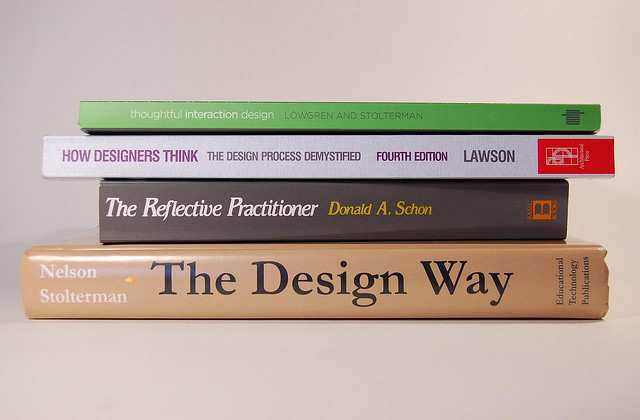
Thesis Paper Books

My thesis paper explores the thinking aspect of design to understand what it is designers actually do so that we can understand our value and communicate it to others. To this end, I read several books, including The Design Way, The Reflective Practitioner, How Designers Think, and Thoughtful Interaction Design. In addition, I reference The Sciences of the Artificial, Designerly Ways of Knowing, and Design Methods.

Advisor: Jodi Forlizzi

Abstract

What designers do—the thinking behind design—is not fully understood. Design is still often viewed as a black art rather than a rigorous discipline. Designers themselves have difficulty explaining how they make the connections that lead to the final solution and why those judgments are valid. While good design work can be done without understanding these forces, it is my hypothesis that the more designers know about the forces involved in design thinking and process, the better they will become as designers and the better they will be able to communicate design to others. This paper examines design as an approach to solving problems and what makes it different from other approaches. It examines design thinking as desire for a particular outcome, a philosophic viewpoint, a conversation, imagination, reason, judgment, wisdom, and a skill. And it explores the nonlinear, dialectical, and unique nature of the design process. Finally, it suggests that designers can view the development of understanding and ability as a design endeavor itself, and that it is possible to design oneself as a designer. Though the audience and focus is on designers, it is my belief that a better understanding of design along with increased ability to communicate design’s rigor and value will ultimately benefit and advance the discipline as a whole.

Download the final paper (pdf)

Portfolio

About

I am a senior designer for Nokia Design, and have a masters of interaction design from the School of Design, Carnegie Mellon University. More about »

Del.icio.us