Archive for the ‘data-visualization’ Tag

Ben Fry Talks Data Visualization

Friday, October 27th, 2006

Ben Fry visited our design studio class again, this time to give a presentation instead of critiquing our work.

He talked about the importance of being able to visualize complex data in order to gain a better understanding of what we’re talking about, for instance, when we say the human genome consists of approximately 35,000 genes.

Ben said mapping such complex data can help us bridge the gap between what we understand, and what we think we understand. Another interesting, but obvious, statement was that there is no trend toward less information. So true.

As one of the creators of processing, he claimed that the tools (Illustrator, Photoshop, Dreamweaver, etc.) don’t tell us how to deal with this complex information. He it seems he believes the tools are constraints. But it’s hard to imagine people not using tools, and instead coding them themselves.

I asked how much of what he does is simply displaying the information versus making it look cool. While his goal is not about making these that look cool, he said, making something that people want to look at certainly helps in making the information accessible.

Some of the more interesting pieces of work that he showed has were mapping of old Atari and Nintendo game code. This he did for fun.

But he did state the importance of learning about data for real projects through experimentation or play. While possibly not practical or useful, it teaches you something about the data they perhaps will influence the final piece.

Overall, the project he presented were interesting enough for me to again consider whether to take a course with him next semester. It also made my curious again about processing, which I haven’t touched since I downloaded it for my data visualization project.

I didn’t use it. But I’m wondering if, as an experiment, I should.

Email Visualization

Saturday, October 7th, 2006

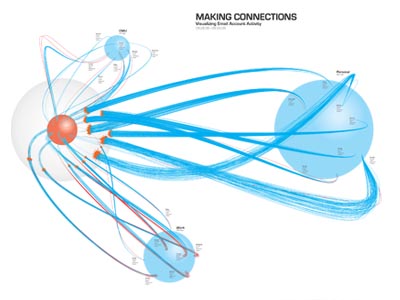
The purpose of this project was to create a self-portrait using data collected about myself over the course of a week and represent it visually.

I started by tracking my communications, then narrowed my focus to three email accounts: personal; work; and school.

Between the sketches and the final, there was a careful balance of time, energy, design, and feedback. The result was quite a dramatic transformation.

The project offered much insight into effectively communicating information through data visualization, and inspired me to explore the subject more by taking an information visualization class with Ben Fry.

The final product was a 34″x32″ poster.

email data visualization

My final product (34″x32″ poster) shows the three email accounts, represented by blue spheres. Blue lines are incoming email. Red lines are outgoing. I get a lot of spam.

data
My communication data I collected over the course of one week.

sketch1
Sketches were key in developing my idea and getting feedback.

sketch2
Based on feedback received from peers, I shifted the orientation of the accounts to the outside with me at the center.

early computer art

I presented this during an individual meeting with Dan Boyarski, who suggested I draw out every email as individual lines, all 682 of them. This idea intrigued me and reminded me of an idea Dan mentioned previously regarding Tufte: don’t be afraid of complexity; put complexity in, and let people build stories from that complexity.

sketch3
But first, I did some more sketches.

close up
Engaging viewers on both the macro and micro level was an important goal for the visualization.

Mapping the Invisible

Wednesday, October 4th, 2006

Today I went to Martin Wattenburg’s lecture on mapping the invisible, during which he highlighted some of his work, including:

I found the above three the most interesting. They’ve been around for a while, so there’s a chance you’ve already seen them. I can’t remember if I had been to NameVoyager, but you should go and look up your name if you haven’t done so.

I learned that “Jamin” came to rise in the 60s and died completely in the mid 90s as a name given to babies. Also, there are about 13 Jamins for every million babies born in the United States during that time period.

(Thirteen is my favorite number.)

As I was born in the 70s, this means I was not the first American Jamin. And if no one begins naming their babies Jamin again, at some point all the Jamins will be gone.

Portfolio

About

I am a graduate interaction design student at the School of Design, Carnegie Mellon University. » More about